Micah Morton featured on Insight Myanmar Podcast

NIU professor of anthropology Micah Morton recorded a just-released episode of the Insight Myanmar Podcast about his 2025 book Enchanted Modernities: Ancestral Vitalizations in the Upper Mekong (University of Wisconsin Press).
In Episode #520: The Akha Way, “Morton begins with an origin narrative many Akha tell about a homeland city-state in the Red River valley, remembered in Akha as Jadae Mirkhanq, with Mirkhanq carrying shifting meanings over time, homeland, city, even ‘country and state’ as Akha find themselves divided among five nation-states and increasingly policed borders. He describes a remembered figure of authority, “the most famous of which is referred to as Aqbawr King Jawrban or Grandfather Jawrban,” credited with laying down the “rules and regulations of governing the ‘Akha way.’” Yet the same past is also remembered as conflict: external pressure from Mongol Yuan incursions around the collapse of the polity, and internal antagonism from factions who “felt King Jawrban was becoming a little bit overbearing,” leading to a plot to assassinate the king. The point is not to settle the history as a single line, but to show how different Akha communities carry different versions and how easy it is for outside scholarship to mistake a local story for a total one.
Against the temptation to romanticize Akha life as naturally ‘anti-state’, Morton stresses the complexity of their relationships with authority. Some groups moved, others “stayed put and consolidated… power and authority and established these long-lived chiefdoms.” Their contemporary geography mountainous border zones encourages a particular outside gaze, but Morton keeps returning to the ways Akha form pragmatic ties with states, militias, and patronage networks, depending on class position, location, and opportunity. Even borders themselves are not simply lines; they are lived regimes, sometimes contested, sometimes loosely enforced, sometimes producing spaces that function as something other than the nation on the map.”
Here is a link to the full recording and synopsis.

CSEAS associate Paul Wright helps NIU connect mind, body, breath with Tai Chi, Qigong
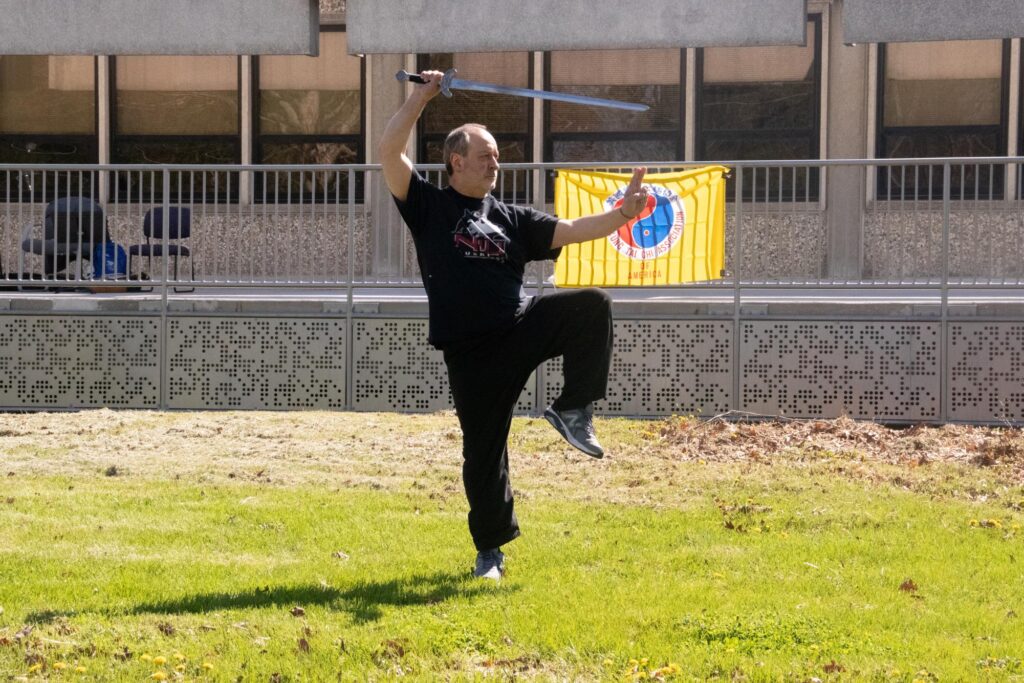
DeKALB — For the second consecutive year, NIU participated in “World Tai Chi & Qigong Day,” with demonstrations of various tai chi forms held from 9:30 a.m. to 11 a.m. Saturday on the front lawn of Anderson Hall.
The College of Kinesiology and Physical Education (KNPE), Office for Student Success, and the College of Education hosted a celebration of “World Tai Chi & Qigong Day,” an annual global event that is observed in over 80 nations including New Zealand, India and the United Kingdom.
The event begins at 10 a.m. local time on the last Saturday of April, starting in New Zealand and ending in Hawaii. Its goal is to spread awareness of the health benefits of traditional Chinese arts while fostering international unity.
The event demonstrated five forms of tai chi and a qigong exercise, all led by tai chi professionals. NIU students performed traditional Chinese music during the demonstrations.
Professor Paul Wright, the KNPE director of graduate studies and certified tai chi instructor, facilitated the event and provided an introduction to what qigong is, explaining that its principles are not much different from yoga.
“Qigong means breath work or effort,” Wright said. “It’s when you’re doing exercises that really coordinate your breathing with the mental focus in your body. You’re focusing entirely on your physical self, with your breathing. Synchronizing that, you’ve brought your body, mind and breath together.”
After demonstrating a qigong breathing exercise and encouraging attendees to follow along, Wright explained what tai chi means in relation to yin and yang, the Chinese philosophy that opposites are interconnected.
“Tai chi means grand ultimate,” Wright said. “It’s the idea of the energy or what’s happening in the universe that gives flow to yin and yang. Tai chi chuan, chuan meaning fist, is the fighting art based on the concept of balancing energy.”
The tai chi demonstrators included head of Wing Tsun Martial Arts Guerman Atanassov, master trainer with the Tai Chi for Health Institute Erica Heinrichs, and owner and instructor at Amalgam Martial Academy Frank Delo.
The tai chi demonstrations featured four styles. The first demonstrated form was traditional Yang family tai chi, which is a slow moving style focused on relaxation. This was followed by tai chi for arthritis and fall prevention, which is designed to improve balance and mobility.
Next was baguazhang, the cousin art of tai chi. Baguazhang involves circular walking movements and directional changes. The last tai chi style demonstrated was tai chi push hands, which is a partner exercise that focuses on improving balance by redirecting force.
Delo explained the difficulty of baguazhang in more depth during his demonstration.
“The difficulty of the circle is because your legs and center are being forced at the same time to go in different directions,” Delo said. “It’s like a compounding effect, that’s part of why we do the circle.”
Lilyanne Daniels, a first-year kinesiology major, was a volunteer at the event and explained why tai chi may be a good alternative to Western exercise.
“It’s a lot more gentle on the body,” Daniels said. “You’ll see a lot of older people here or people who just don’t exercise a lot, because it’s an easy way to start and it is very good for the body.”
As the final demonstration wrapped up, Wright encouraged attendees to sign a contact sheet for information about the Tai Chi club and general updates on future events.
Students interested in the tai chi club can visit its page on huskie hub
